

MNEXT > Vacatures > FungAI: Optimizing Mycelium Bio-Composites through Quality Control using Computer Vision
Stage

FungAI: Optimizing Mycelium Bio-Composites through Quality Control using Computer Vision

Do you want to use AI to contribute to a more sustainable world? In the FungAI project, you will apply computer vision and machine learning to automatically assess the quality of mycelium bio-composites. You will work on a practical and socially relevant project at the intersection of AI, data, and sustainable materials.
Startdatum 01 January 2026
Solliciteren voor 31 January 2026
Ervaring Stage
Locatie Breda
Solliciteren

Background

As sustainable building methods gain momentum, bio-based materials are increasingly explored as alternatives to conventional construction and insulation products. Mycelium bio-composites (MBCs) are a promising class of materials, offering a renewable, low-impact substitute for products such as MDF, EPS, and PIR insulation. In these composites, fungal mycelium grows through agricultural residual substrates (e.g. straw, hemp shives, grass, or pepper stems) and acts as a natural binder.

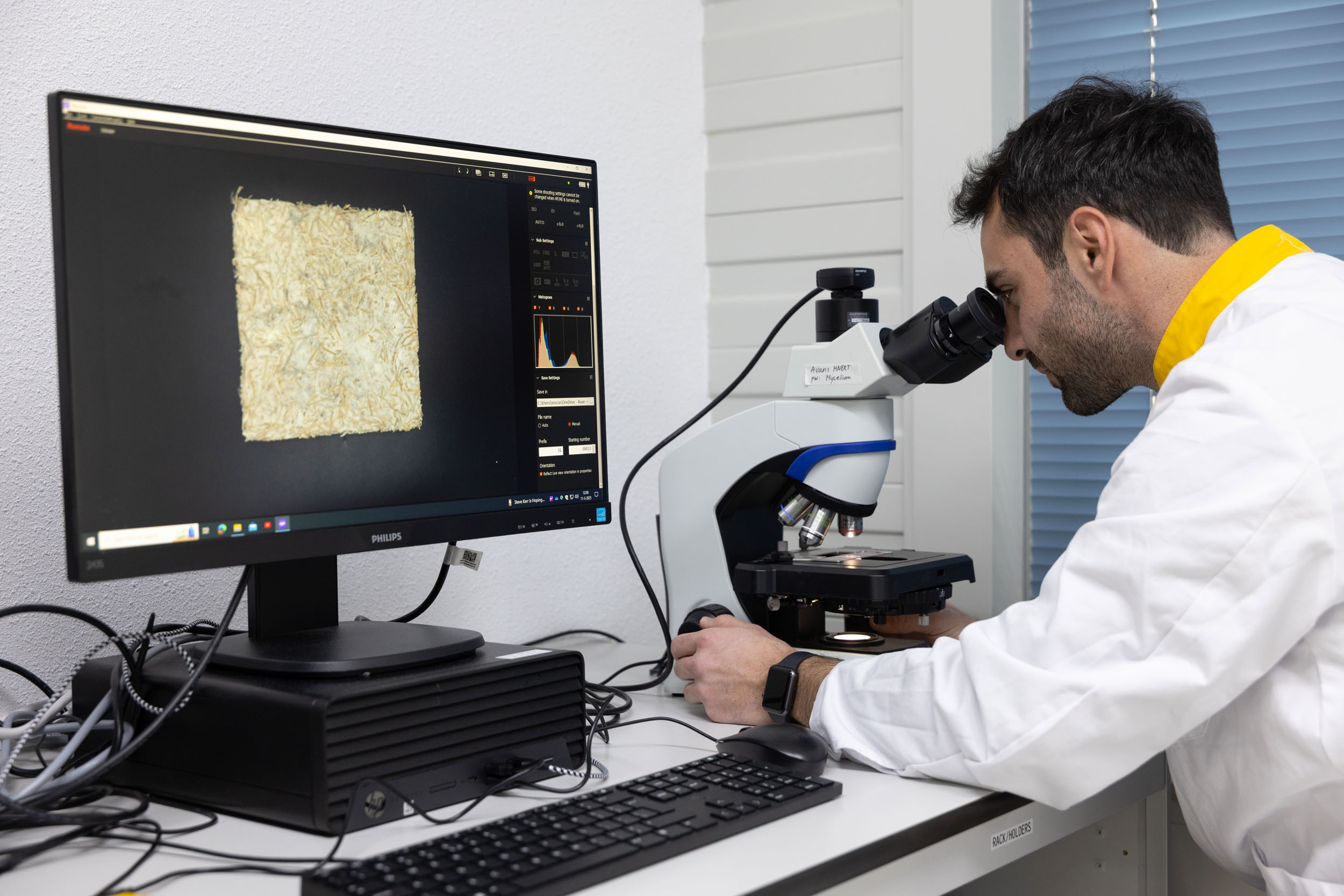
While mycelium bio-composites are approaching market readiness, consistent quality control remains a major challenge. Proper colonization is critical for mechanical performance and durability, yet current assessment methods are largely manual, time-consuming, and difficult to scale. To support industrial adoption, MNEXT is developing AI-based monitoring systems that can automatically assess mycelium growth and material readiness.

Assignment Description

As an intern at MNEXT, you will have the opportunity to participate in the project ‘FungAI’ which focuses on automating the assessment of mycelium bio-composites growth using artificial intelligence. Your primary role will be on the AI and data side. You will contribute to the design, training, and validation of AI models that can distinguish between properly colonized mycelium bio-composites and samples that require further growth or intervention. The resulting system will support scalable, reliable quality control for applications in packaging, construction, and fashion.

Your tasks will include:

  • Develop and fine-tune AI models for assessing mycelium growth quality based on image and sensor data.
  • Validate and improve model accuracy, robustness, and generalization across different substrates and growth conditions.
  • Optimization and Brainstorming: Collaborate with the team to identify potential improvements to the monitoring system and outline next steps for further research.

We are looking for a student with:

  • A background in Artificial Intelligence, Data Science, Computer Science, or a related field.
  • Experience with machine learning and computer vision (e.g. PyTorch, TensorFlow,).
  • Interest in applied AI within sustainability, bio-materials, or industrial processes.
  • Ability to work independently while collaborating in a multidisciplinary research team.

Working language: we have a multidisciplinary and international team. Therefore, the language is English. Some of the researchers also speak Dutch.

Starting Date & Compensation

February 2025. The length of the internship assignment is approximately 20 weeks. The student will get an internship compensation of €350, – per month.

Contacts

  • Sára Finta (sk.finta@avans.nl )
  • Tim Verschuren (t.verschuren3@avans.nl )
Meer informatie? Neem contact op met:

Tim Verschuren

Mail t.verschuren3@avans.nl Solliciteer direct

Meer vacatures

FungiZap: Energy-efficient deactivation of mycelium using high-voltage technologies and alternative techniques
Breda
Stage
Beyond Wood: Impact of building materials on indoor air quality
Breda
Stage
DeDye – Redye: Decolorization and Recoloring of Polyester fabrics for a Closed Circular Chain
Breda
Stage
DeCoTex: DeColorisation of Textile with Supercritical CO2 for Recycling
Breda
Stage
CASCO – performance of bio-based insulation; theory vs. practise
Breda
Stage
CASCO: Sustainability Calculation Tools
Breda
Stage
Sustainable Conversion of Waste CO₂ to Methanol – A Process Simulation Approach
Breda
Stage
Experimental Validation of High-Temperature Co-Electrolysis of CO₂ and Steam to Syngas Using Solid Oxide Electrolysis Cells (SOEC)
Breda
Stage
Fabrication of Functionalized Biochar Electrodes with Metallic Co-Catalyst for the Hydrogen Evolution Reaction (HER)
Breda
Stage
Process Simulation of Hydrogen-Based DRI Steelmaking Combined with High-Temperature Electrolysis
Breda
Stage
MycEoLA: Prototyping End-of-Life Possibilities for Mycelium Bio-Composites
Breda
Stage
Improving Biodegradability of Coatings Through Pretreatment
Breda
Stage
Environmental impact: Chemical vs mechanical recycling
Breda
Stage
ABEL: Mapping and valorisation of low-grade biomass for a biobased circular economy
Breda
Stage
Biobased Adhesive Development
Breda
Stage
Development of biobased polymer additives using lignin
Breda
Stage
BioColEol: Development and testing of masterbatches with sustainable curcumin-derived colorants
Breda
Stage
BioColEol: Improving stability and application potential of natural colorants through chemical modification
Breda
Stage
MycoClay: Mechanical investigation of mycelium-clay components for the built environment
Breda
Stage
MycoClay: Feasibility investigation of mycelium-clay components for the built environment
Breda
Stage
Upgrading underutilized plant-based sources into valuable food ingredients and products
Middelburg
Stage
Protein Digestibility of Fermented Seaweed and Foods
Middelburg
Stage
LApure – Process development for lactic acid recovery
Breda
Stage
(Afstudeer-)stage in Brazilië via Living Lab Biobased Brazil
Stage