


This afternoon focuses on the practical aspects of mechanical recycling: sorting, cleaning, grinding, and conditioning plastic streams. You’ll gain insight into the choices you make in each step, the equipment used, and how this affects product quality, costs, and environmental impact.
Afterward, you’ll go home with:
- Concrete tools to improve the sorting, cleaning, and pretreatment of your own plastic streams;
- greater insight into the position of mechanical versus chemical recycling routes;
- an extensive network in the circular plastics chain in the South of the Netherlands/West Brabant.
For whom?
The training is suitable for:
- (Process) engineers, technologists, and R&D staff working or wanting to start working with plastics recycling;
- quality and operations managers at recyclers, waste processors, and plastics processing companies;
- policymakers, consultants, and project leaders active in the circular economy and plastics chains;
- students and job seekers (mbo/hbo/wo) who want to explore a career in recycling and circular plastics.
What will you learn?
This afternoon we will cover the complete pretreatment chain for plastic waste:
Overview of mechanical recycling
- Position of mechanical recycling within the total recycling chain (versus chemical routes).
- Basic steps: collection, sorting, pretreatment, grinding, washing, extrusion, and compounding.
Pretreatment of plastic streams
- Typical input streams: post-consumer, post-industrial, mono- and mixed streams.
- Removal of contaminants, metals, organic residues, labels, and unwanted materials.
- Importance of good pretreatment for product quality (color, odor, mechanical properties).
Sorting and identification
- Sorting by polymer type, color, and size.
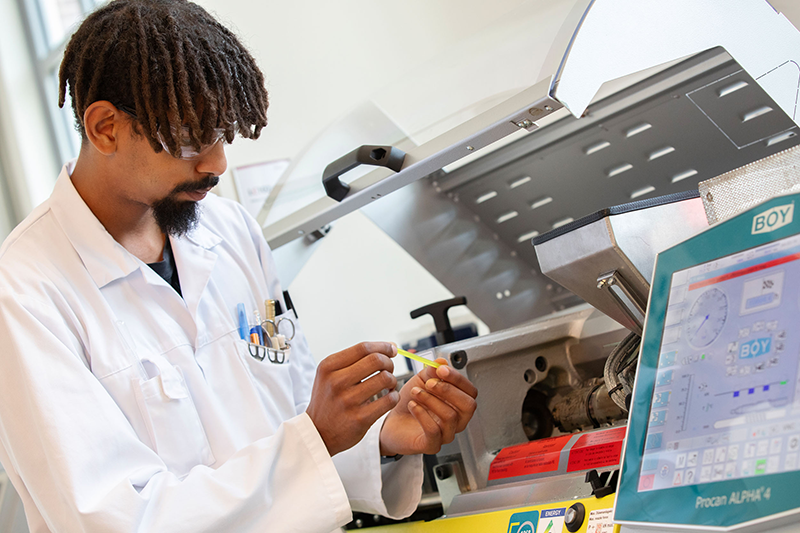
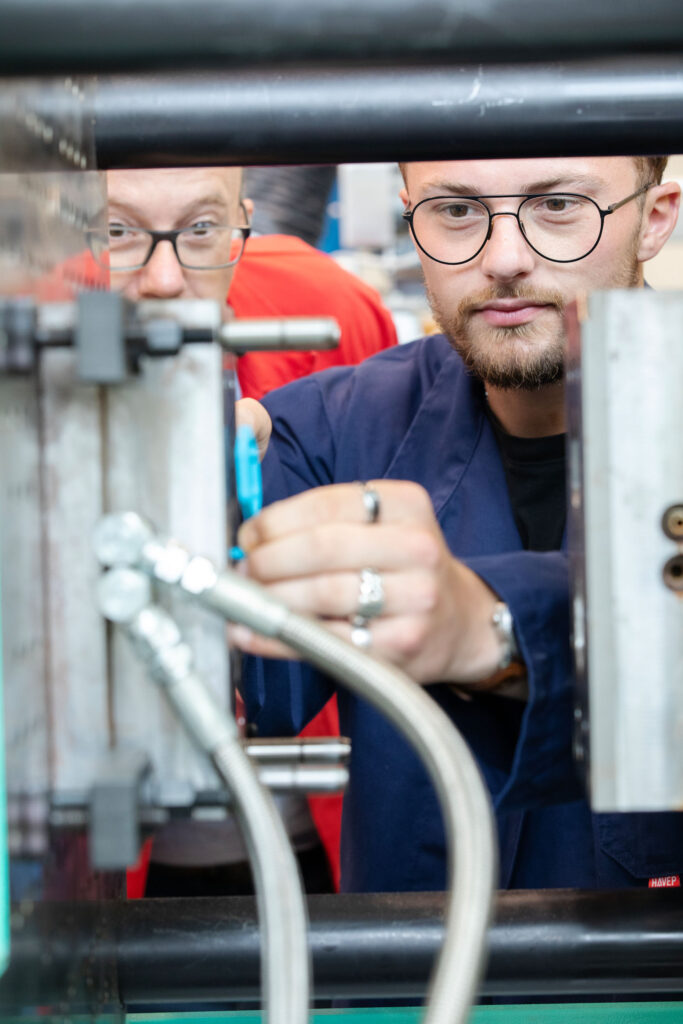
You will also receive practical examples from NPSP and other project partners, and in the lab, you will see what shredding and grinding look like in practice.
Program
2:00 PM – 2:30 PM – Welcome, coffee/tea & introduction
Introduction to the JTF project CRecycle and NPSP’s role as a practical partner. Introduction to the trainers and participants: what is your background and which plastics streams do you work with?
2:30 PM – 2:50 PM – Plastic Waste Management in the Netherlands
Eric Petersen (Agricon) will outline the Dutch plastics waste chain and the role of mechanical recycling within it.
2:50 PM – 3:00 PM – Questions & discussion
3:00 PM – 3:10 PM – Introduction to NPSP
Willem Bottger (NPSP) will discuss NPSP and case studies involving recycled plastics and composites.
3:10 PM – 3:30 PM – Mechanical Recycling of Composites (English)
Aditya Babu (NPSP) on the basic principles, challenges, and opportunities of mechanical composite recycling.
3:30 PM – 3:40 PM – Discussion and practical application
3:40 PM – 3:50 PM – Break & walk to the lab
3:50 PM – 4:30 PM – Lab tour & hands-on
Tour and hands-on experience with shredding and grinding (composite) plastics.
4:30 PM – 5:00 PM – Closing remarks & networking
Summary, Q&A session, and networking with experts, project partners, and other participants.
Afterward, you will receive a certificate of participation.
The C-Recycle project has a total budget of €3.5 million and is co-financed by the European Union, the Ministry of Economic Affairs and Climate Policy, and the Ministry of Social Affairs and Employment, through the Just Transition Fund.