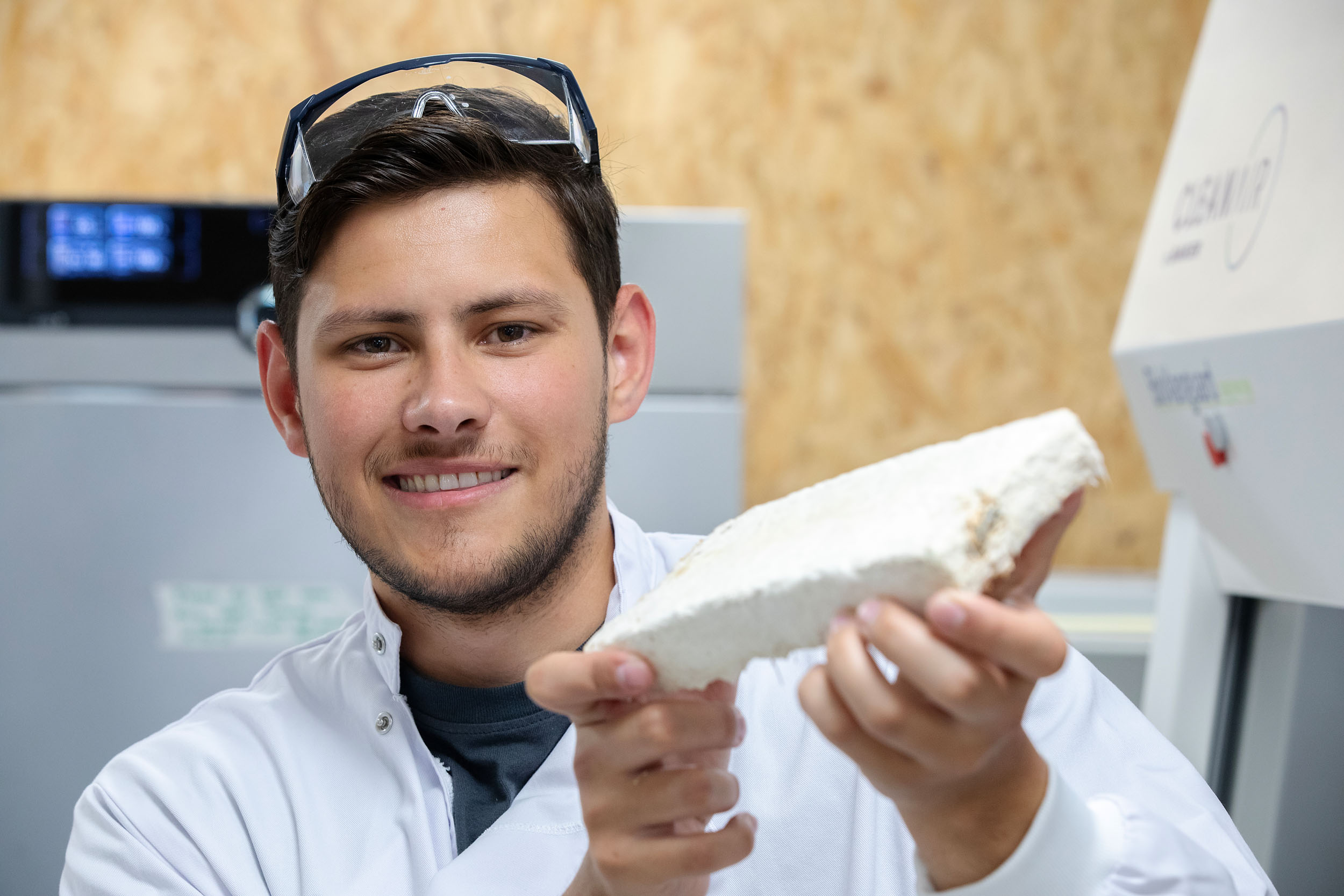
BackgroundMycelium bio-composites (MBCs) are emerging as sustainable alternatives to conventional insulation and packaging materials. These materials are produced by growing fungal mycelium on agricultural residues, where the mycelial network binds the fibers into a solid composite. Before industrial use, fungal growth must be deactivated to prevent regrowth and ensure material stability. Currently, deactivation is mainly achieved through long, high-temperature oven drying, which is energy-intensive and can negatively affect material properties. The FungiZap project investigates innovative, low-energy alternatives based on high-voltage electrical treatments, specifically Pulsed Electric Fields (PEF) and Cold Plasma (CP), to deactivate mycelium while preserving material performance. Assignment DescriptionAs an intern at Avans University of Applied Sciences (MNEXT), you will participate in the FungiZap project, which focuses on developing and evaluating high-voltage deactivation strategies for mycelium bio-composites. Part of the experimental work will be carried out at Avans (Breda), while specialized high-voltage treatments will be performed at the TU Delft High Voltage Laboratory. You will work with mycelium materials intended for applications in construction and packaging and contribute to understanding how electrical treatments affect fungal viability and material quality. Objectives of the project
Main tasks
Working language: we have a multidisciplinary and international team. Therefore, the language is English. Some of the researchers also speak Dutch. Starting Date & CompensationFebruary 2025. The length of the internship graduation assignment is approximately 20 weeks. The student will get an internship fee of €350, – per month. Contacts· Internship Supervisor: Stefano Roccio (s.roccio@avans.nl ) |
Powered by




Stage
FungiZap: Energy-efficient deactivation of mycelium using high-voltage technologies and alternative techniques
Are you interested in sustainable materials and innovative high-voltage technologies? In this internship or graduation project, you will explore energy-efficient methods to deactivate mycelium bio-composites using techniques such as Pulsed Electric Fields and Cold Plasma.
Startdatum
01 December 2025
Solliciteren voor
31 January 2026
Ervaring
(Graduation) Internship
Locatie
Breda
Meer informatie? Neem contact op met:
Totally Nuts: Separation of cardol and cardanol compounds in cashew nut shell liquid oil (CNSL)
Breda
Stage
DeDye – Redye: Decolorization and Recoloring of Polyester fabrics for a Closed Circular Chain
Breda
Stage
Experimental Validation of High-Temperature Co-Electrolysis of CO₂ and Steam to Syngas Using Solid Oxide Electrolysis Cells (SOEC)
Breda
Stage
Fabrication of Functionalized Biochar Electrodes with Metallic Co-Catalyst for the Hydrogen Evolution Reaction (HER)
Breda
Stage
Process Simulation of Hydrogen-Based DRI Steelmaking Combined with High-Temperature Electrolysis
Breda
Stage
BioColEol: Development and testing of masterbatches with sustainable curcumin-derived colorants
Breda
Stage
BioColEol: Improving stability and application potential of natural colorants through chemical modification
Breda
Stage
MycoClay: Mechanical investigation of mycelium-clay components for the built environment
Breda
Stage
MycoClay: Feasibility investigation of mycelium-clay components for the built environment
Breda
Stage