

MNEXT > Vacatures > MycoClay: Feasibility investigation of mycelium-clay components for the built environment
Stage

MycoClay: Feasibility investigation of mycelium-clay components for the built environment

Are you passionate about sustainable construction and curious how biology can change the way we build? In this research internship, you will explore MycoClay: a novel combination of mycelium and clay as a biobased alternative to cement in concrete. You will gain hands-on experience in the lab, help define the properties of this new material, and contribute to the transition towards a more sustainable built environment within the Biobased Construction team at MNEXT.
Startdatum 02 February 2026
Solliciteren voor 30 January 2026
Ervaring Internship or graduation internship
Locatie Breda
Solliciteren

About MNEXT and the Biobased Construction Team

The construction industry has a major environmental impact: it consumes vast amounts of resources and concrete production alone is responsible for a significant share of global CO₂ emissions. Cement, a key ingredient in concrete, accounts for around 8% of global CO₂ emissions and drives large-scale extraction of finite raw materials, with consequences such as habitat destruction, biodiversity loss, and social inequality. While many research initiatives are exploring sustainable and biobased concrete, challenges remain in durability, scalability, and compliance with strict performance standards.

At MNEXT, the Biobased Construction team focuses on the materials transition within the built environment. Our researchers are spread across Breda, Den Bosch, and Middelburg, with diverse fields of expertise. You will join a supportive, multidisciplinary environment where collaboration and innovation are central.

Assignment Description

This feasibility study investigates the potential of binding clay with mycelium to develop a biobased alternative to cement in concrete production.

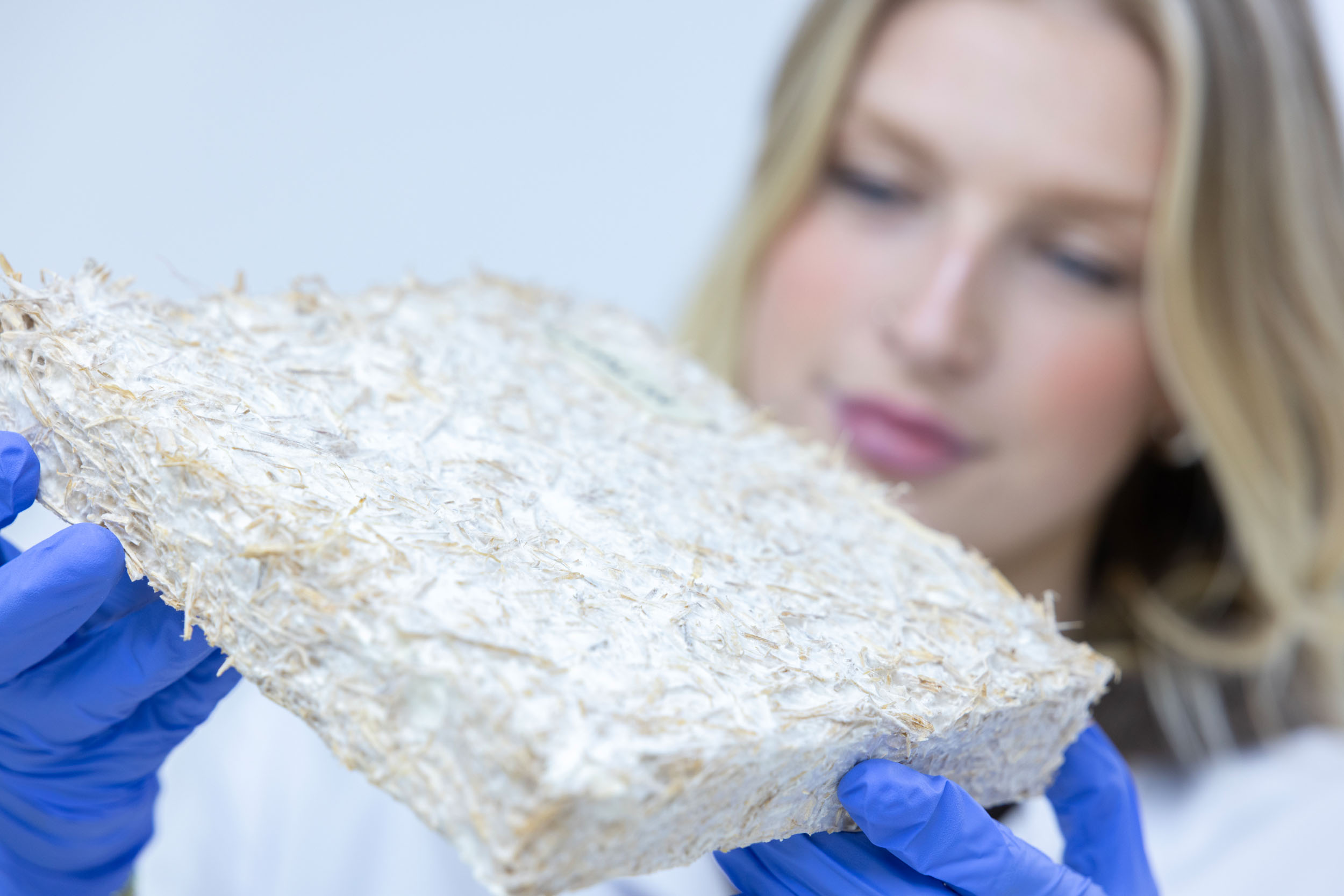
MycoClay leverages mycelium’s natural binding capabilities and clay’s structural properties to create a circular, durable component that could partially or fully replace cement. Because this combination is largely unexplored, the research will focus on systematically studying different mycelium–clay–fibre combinations and assessing their properties.

Your main tasks will include:

  • Conducting a thorough literature review to map out existing research and currently tested properties
  • Working in the mycelium laboratory to fabricate material samples (in-person at the JRCB laboratory facilities in Breda)
  • Performing property tests to establish the material boundaries and performance of different combinations
  • Brainstorming potential applications and developing early-stage prototypes
  • The findings will demonstrate mycelium’s capacity to bind with clay and help narrow down promising formulations for further development of MycoClay-inspired concrete. Your work will form an important foundation for future sustainable biobased construction materials.

Desirable Skills

We are looking for a student who:

  • Can work independently and carry out laboratory research after an introduction
  • Has a background in materials science, environmental science, product design, and/or biology
  • Is studying at HBO or university level (both are welcome)
  • Is motivated to contribute to sustainable construction and enjoys hands-on experimentation
  • Is comfortable working in an international, research-driven environment

Practical Details

Location
JRCB laboratory facilities, Breda (with a broader Biobased Construction team across Breda, Den Bosch and Middelburg).

Internship Duration
Approximately 20 weeks (graduation or internship assignment; starting date to be agreed upon).

Working Language
English.

Compensation
Internship fee of €400 per month.

Meer informatie? Neem contact op met:

Neha John

Mail ns.john@avans.nl Telefoon 31885257072 Solliciteer direct

Meer vacatures

Totally Nuts: Separation of cardol and cardanol compounds in cashew nut shell liquid oil (CNSL)
Breda
Stage
DeDye – Redye: Decolorization and Recoloring of Polyester fabrics for a Closed Circular Chain
Breda
Stage
DeCoTex: DeColorisation of Textile with Supercritical CO2 for Recycling
Breda
Stage
CASCO – performance of bio-based insulation; theory vs. practise
Breda
Stage
CASCO: Sustainability Calculation Tools
Breda
Stage
Sustainable Conversion of Waste CO₂ to Methanol – A Process Simulation Approach
Breda
Stage
Experimental Validation of High-Temperature Co-Electrolysis of CO₂ and Steam to Syngas Using Solid Oxide Electrolysis Cells (SOEC)
Breda
Stage
Fabrication of Functionalized Biochar Electrodes with Metallic Co-Catalyst for the Hydrogen Evolution Reaction (HER)
Breda
Stage
Process Simulation of Hydrogen-Based DRI Steelmaking Combined with High-Temperature Electrolysis
Breda
Stage
MycEoLA: Prototyping End-of-Life Possibilities for Mycelium Bio-Composites
Breda
Stage
Improving Biodegradability of Coatings Through Pretreatment
Breda
Stage
Environmental impact: Chemical vs mechanical recycling
Breda
Stage
ABEL: Mapping and valorisation of low-grade biomass for a biobased circular economy
Breda
Stage
Biobased Adhesive Development
Breda
Stage
Development of biobased polymer additives using lignin
Breda
Stage
BioColEol: Development and testing of masterbatches with sustainable curcumin-derived colorants
Breda
Stage
BioColEol: Improving stability and application potential of natural colorants through chemical modification
Breda
Stage
MycoClay: Mechanical investigation of mycelium-clay components for the built environment
Breda
Stage
Accelerating Training Processes and Improving Network Technology Knowledge for Specialized Electrical Installations within Energy Hubs
Breda
Stage
Upgrading underutilized plant-based sources into valuable food ingredients and products
Middelburg
Stage
Protein Digestibility of Fermented Seaweed and Foods
Middelburg
Stage
LApure – Process development for lactic acid recovery
Breda
Stage
(Afstudeer-)stage in Brazilië via Living Lab Biobased Brazil
Stage