


The project connects two research lines within the Biobased Construction researchgroup: the ‘Building with EARTH line’ and the ‘Building with MYCELIUM line.’ The EARTH construction line focuses on clay and rammed earth as materials that can return to the earth after use, and the MYCELIUM line on creating sustainable biocomposites using mycelium with local agricultural fibrous waste. By combining these insights, MycoClay supports the development of circular construction materials.
Clay characterization and testing at JRCZ
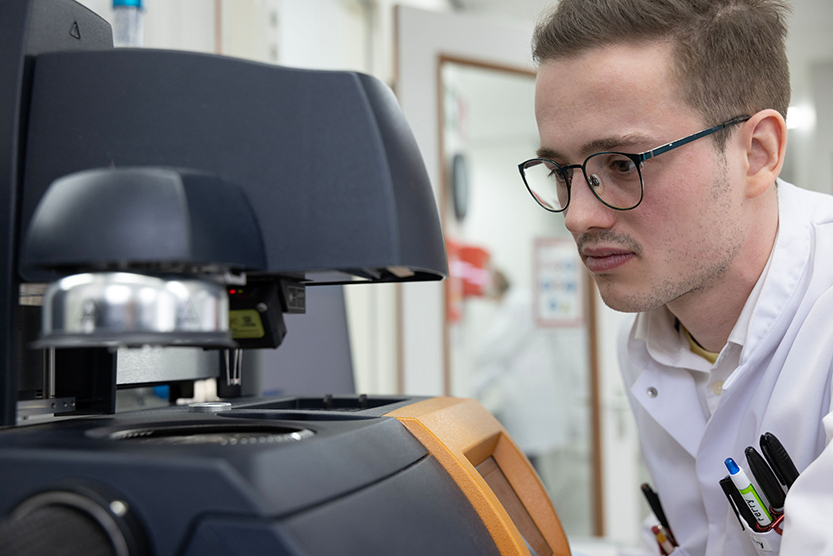
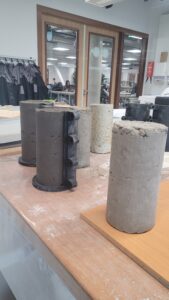
In JRCZ, the focus is on the raw material analysis, since the clay is harvested from Zeeland and there is an established research line on clay. Here, the clay is examined based on its composition, particle size, salt content, and other fundamental properties to determine how the material would behave in a mycelium biocomposite. Neha explains: “It is essential that we first understand well which clay types are suitable and how variables such as moisture and organic content affect the final product. Only in this way can we later make reliable biocomposites.”
In addition to characterization, researchers and students also test biobased coatings and natural adhesives, such as alginate from brown algae and chitosan from shrimp. This provides opportunities to bind and coat clay in an environmentally friendly way, without chemical additives. The lab in Zeeland thus maps the basic knowledge needed for an optimal combination of clay and mycelium, and for developing robust and sustainable biocomposites.
Developing clay-mycelium composites at JRCB
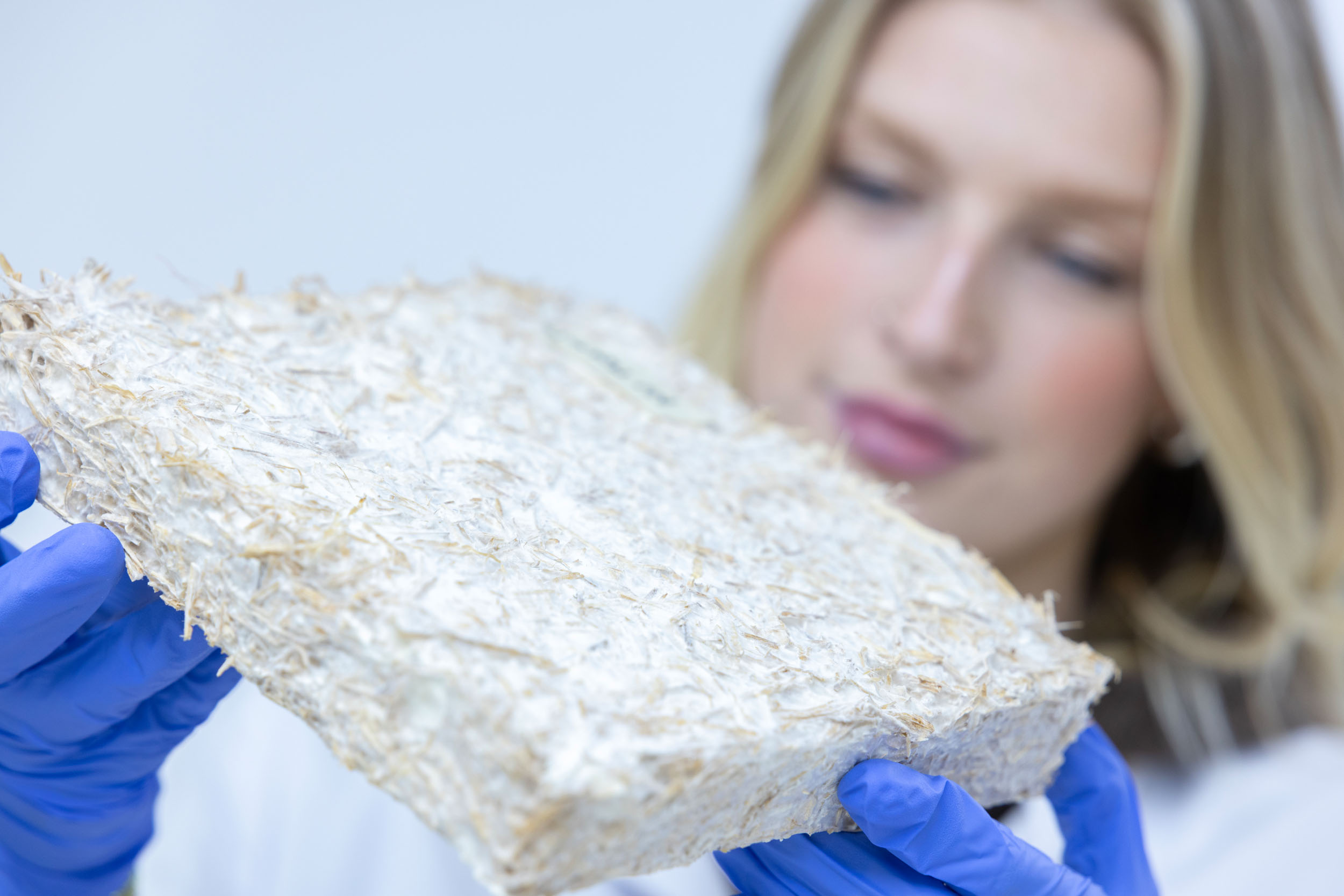
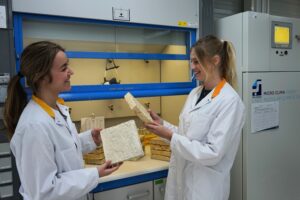
In JRCB in Breda, the focus is on applying the raw materials to create functional materials. Here, the clay is combined with selected mycelium species to make small prototypes and components. Different processing methods are tested, such as dry versus wet clay, and the optimal ratio between mycelium and clay. Neha: “In Breda, we experiment with different processing methods, such as dry versus wet clay, and investigate which ratio between clay and mycelium ensures optimal growth and binding. Our goal is to develop a protocol for future students and researchers. This way, they can build on our work and contribute to scalable, sustainable materials.”
The facilities in Breda are equipped for safe handling of living organisms, including autoclaves and biohazard safety, which is necessary for processing mycelium by researchers and students. By testing combinations and growth conditions, a hybrid material is created that is both structurally robust and biologically sustainable.
Innovation and challenges
An important challenge of MycoClay is combining clay and mycelium. Both act as binders but have opposing requirements: clay works best in a dense, low-air environment, while mycelium needs air and moisture to grow. Neha: “It is interesting to see how both components interact. We try different methods, such as adding fibers as nutrition for the mycelium, and investigate which method ensures optimal growth.”
By bringing together the experiments in JRCZ and JRCB, insight is gained into how clay and mycelium can be processed into materials that are not only functional but also fully circular; materials that can return to the earth after use.
Students and circularity
Students are actively involved in the research process, from characterization to prototype development. In this way, MycoClay also serves as a learning tool: students learn to think circularly, understand the full chain of material development, and gain practical experience with sustainable building materials.
From lab to application and impact
What began in Zeeland with understanding clay and its properties continues in Breda in the form of prototypes and material development. In this way, MycoClay gradually progresses towards practical application. Neha: “The research in the labs provides us with the insights needed to develop materials that are both practically applicable and environmentally friendly.”
With this knowledge, a clear path forward emerges: first, find the ideal combination of clay and mycelium and optimize the manufacturing procedures. Only then can attention turn to components that in the future could sustainably replace cement or concrete in circular construction projects.
Neha concludes: “Our project is modest, but with the right approach it can have a big impact on the circular construction materials of the future.”