



The assignment
Your internship is part of the BioColEol project. So far, the main focus has been on optimising the chemical structure of curcumin, a natural yellow dye derived from turmeric root that is already widely used in the food industry. The limited UV stability of curcumin hampers its use in other sectors, such as the plastics industry. Targeted chemical modifications have already led to significant improvements in the chemical, thermal and UV stability of curcumin-based dyes.
Within the project, the focus is now shifting towards a broader range of biobased dyes, including anthraquinones and anthocyanins. The aim is to further improve the stability and applicability of these dyes. During your internship you contribute directly to this work. You may focus on further optimisation of existing curcumin derivatives, or on the development and improvement of alternative biobased dyes.
You will be involved in both synthesis and analysis. You characterise the produced dyes using techniques such as HPLC, LC-MS, NMR, FT-IR, UV-Vis, TGA and DSC. You can also process the developed dyes into polymers and study properties such as lightfastness and colour characteristics using the CIELAB colour space.
This internship is a good fit for a bachelor’s or master’s student in chemistry or a related field, with experience and a strong interest in organic synthesis. Experience with HPLC, NMR, FT-IR, LC-MS and UV-Vis is desired. A good command of both Dutch and English is required.
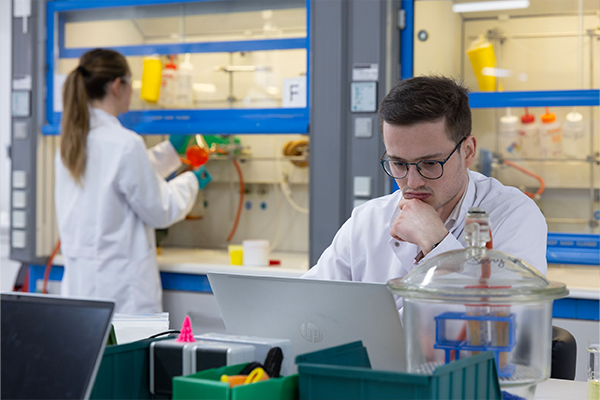
The internship takes place at the Joint Research Centre Breda, where you will work with new equipment in an innovative research setting. Two internship positions are available.
About MNEXT
MNEXT is the Centre of Expertise for the materials and energy transition. Together with companies, governments, researchers and students, MNEXT bridges the gap between innovation and society and works on practice-oriented research for a sustainable future. Projects are organised within three main themes: transition and value creation, sustainable energy technologies, and biobased and circular materials.
As an intern or graduation student, you are a full member of a multidisciplinary research team and work on real-life questions from the professional field. Every semester, dozens of students do an internship at MNEXT. This means you work closely with many other students, build a strong network and also enjoy plenty of social interaction.
During your internship you automatically take part in an internship programme with more than ten workshops. These workshops help you develop both research skills and career competencies – from using AI in desk research and dealing with research integrity to the professional use of LinkedIn and coaching to further develop your own start-up ideas.
You receive an internship allowance of €350 per month.