


What is MycoClay?
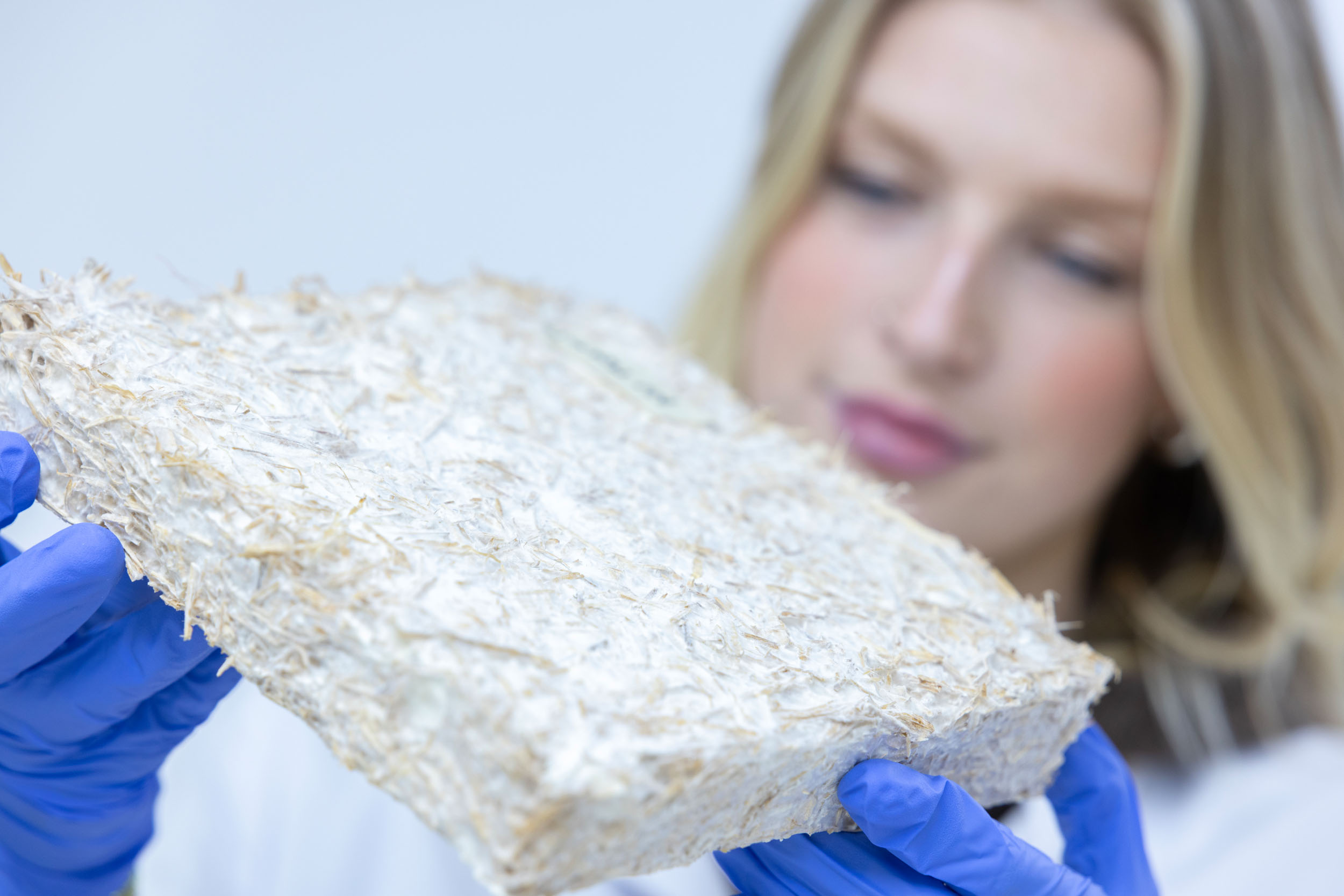
To understand exactly what the students are researching, here is a brief explanation of the project. The MycoClay project is a feasibility study into how clay and mycelium can be combined into a component for the built environment. John explains: “Our goal is for this to serve as a cement replacement, and with gravel, perhaps even as a concrete replacement. We are looking for a process that is continuous, more efficient, and easier to manufacture. The end result must ultimately be able to return to the earth.”
The project is carried out in collaboration with ABT Consulting and forms a bridge between two research lines within the research group BioBased Construction: the ‘Building with EARTH line’ and the ‘Building with MYCELIUM line.’
The EARTH construction line focuses on clay and rammed earth as materials that can return to the earth after use.
The MYCELIUM line investigates how mycelium with local agricultural fibrous waste can be applied to create sustainable biocomposites. In this way, MycoClay combines knowledge of clay, natural coatings, and processing methods with innovative mycelium research, enabling the development of circular construction materials.
From Field to Pond: Students Bring MycoClay to Life
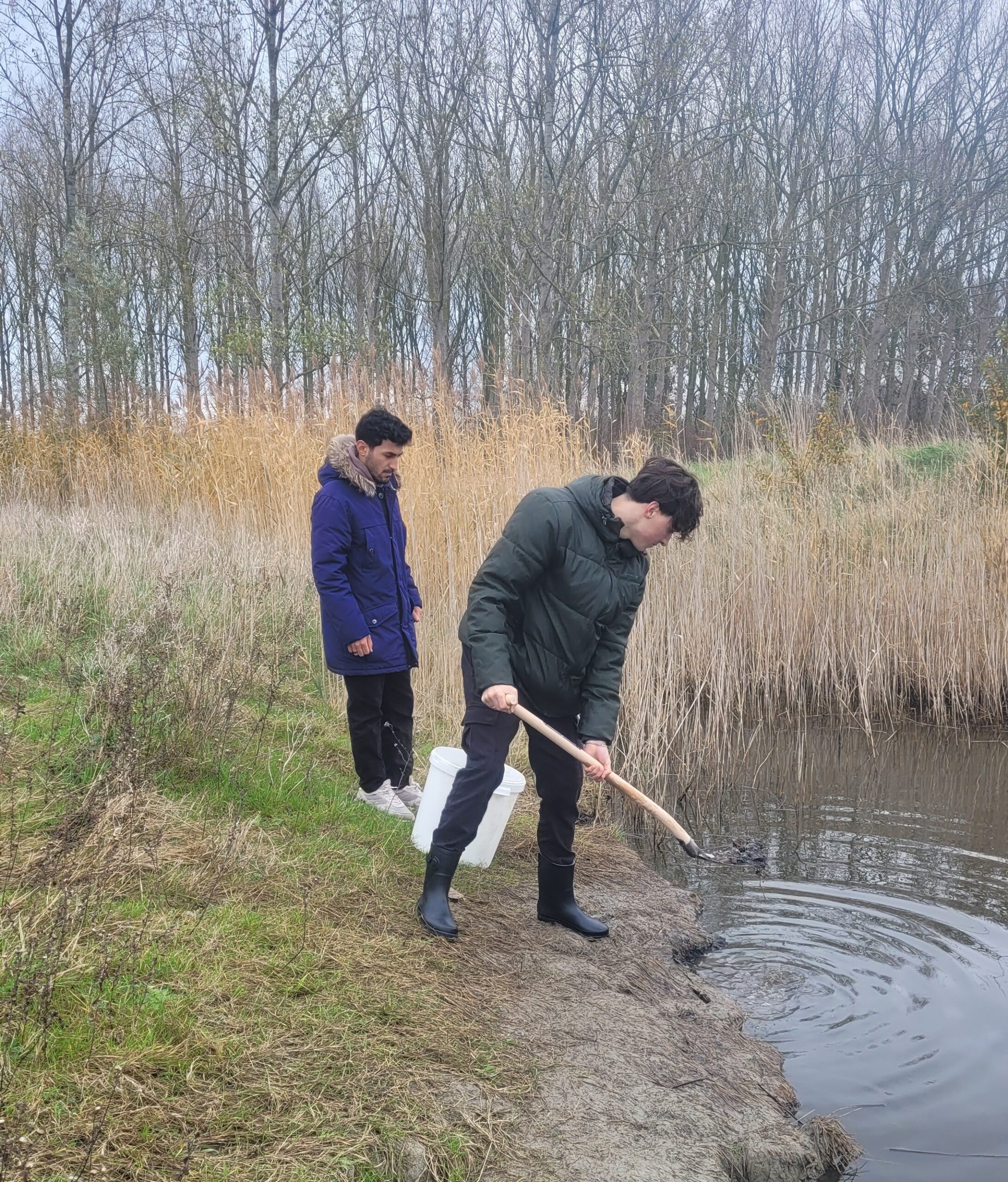
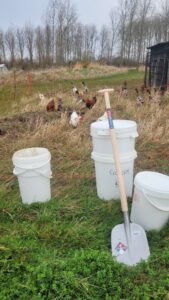
At OEST Farm & Stay, a farm on the Zeeland estate Hof ter Linde, students shoveled clay. They had previously collected clay from the field for a previous project (Biobased Wet Cell). Now they shoveled clay from the pond, only a few meters away, where clear differences were already visible. “You can see the difference, you can smell the difference, and that affects how the material later reacts in combination with mycelium,” John explains. The pond clay contained small fibers, but that is not a problem because the clay will be autoclaved to sterilise and kill the organic materials.
By shoveling themselves, students experienced how much labor was needed to utilize natural raw materials. John: “When students shovel the clay themselves, they are more careful with it in the lab. They understand that materials do not arise by themselves and that waste must be prevented.” She explains that this helps them understand how to handle materials carefully and why sustainability and circularity are important. It gives them an idea of the entire cycle: from source to application.

From Shovel to Lab
After collection, the clay was characterized and tested at the lab in the Joint Research Centre Zeeland (JRCZ) in Zeeland for salt content, shrinkage, and other fundamental properties. John: “We also investigate biobased coatings and natural adhesives, for example based on alginate from brown algae or chitosan from shrimps, to see if we can bind clay and coat it in a sustainable way.” After these analyses, the material is brought to the lab in the Joint Research Centre Breda (JRCB) in Breda, where the application with mycelium is studied. Here, components are made for use with mycelium and small prototypes are produced. John: “Here we study which mycelium species grow best on autoclaved-treated clay. The goal is to develop a protocol for fabricating components so that students and researchers can build on it.”
Challenges and Learning by Doing
Combining clay and mycelium proves to be an interesting puzzle. Both clay and mycelium are binders, but they have opposing needs. Clay works best as a dense mass without air, while mycelium needs air to grow. When combined, a hybrid matrix is created. It is a challenge to ensure homogeneity so that the center of a component also has enough mycelium growth, while the surface is already exposed to air. Therefore, different methods are explored: letting dry clay particles bind with mycelium or using a more moist clay mix with fibers as nutrition for the mycelium.
The MycoClay project shows that practice-based research is essential. Students do not only see the result, but also experience the entire process: from extracting the clay to processing it in the lab. They learn how properties such as structure, salt content, and moisture affect the result and how this knowledge can lead to a material suitable as a cement replacement.
John emphasizes the students’ learning process: “By working with the material themselves, students become aware of the entire chain: from source to prototype. It shows that sustainability starts at the base, with the material itself. They learn to think circularly and experience that materials such as clay and mycelium can return to the earth. This not only contributes to sustainable building but also to soil restoration.”
Future and Impact
John explains the next steps of the research. The goal is first to develop a cement replacement and then, with gravel and other aggregates, a concrete-like variant. But first, the ideal combination, proportions, and manufacturing procedures of clay and mycelium must be determined. As John says: “With the right approach, this can have a great impact on the future of circular construction materials.”
The Value of Experience
Shoveling clay and working with MycoClay is a lesson in awareness, engagement, and responsibility. John concludes: “It is an intensive day, but students take away more than just knowledge. They feel the complexity of sustainable material development, and that gives them energy to later contribute themselves to circular and innovative construction solutions.”