


MNEXT collaborated on the project with Paques Biomaterials, Looop, and Cargill. Project leader Mithyzi Andrade Leal, researcher in Biobased Resources & Energy at MNEXT, looks back with pride:
“We have learned a lot about converting waste streams into valuable building blocks for bioplastics. These insights bring us closer to a stable, scalable PHA production process.”
PHA: fully biodegradable bioplastic
PHA (polyhydroxyalkanoates) is a bioplastic produced by bacteria. The material is fully biodegradable in natural environments and offers a sustainable alternative for products where degradation is important.
The foundation for PHA is formed by volatile fatty acids such as acetic acid and lactic acid. These are produced when bacteria break down organic substances in wastewater, such as starch and sugars.
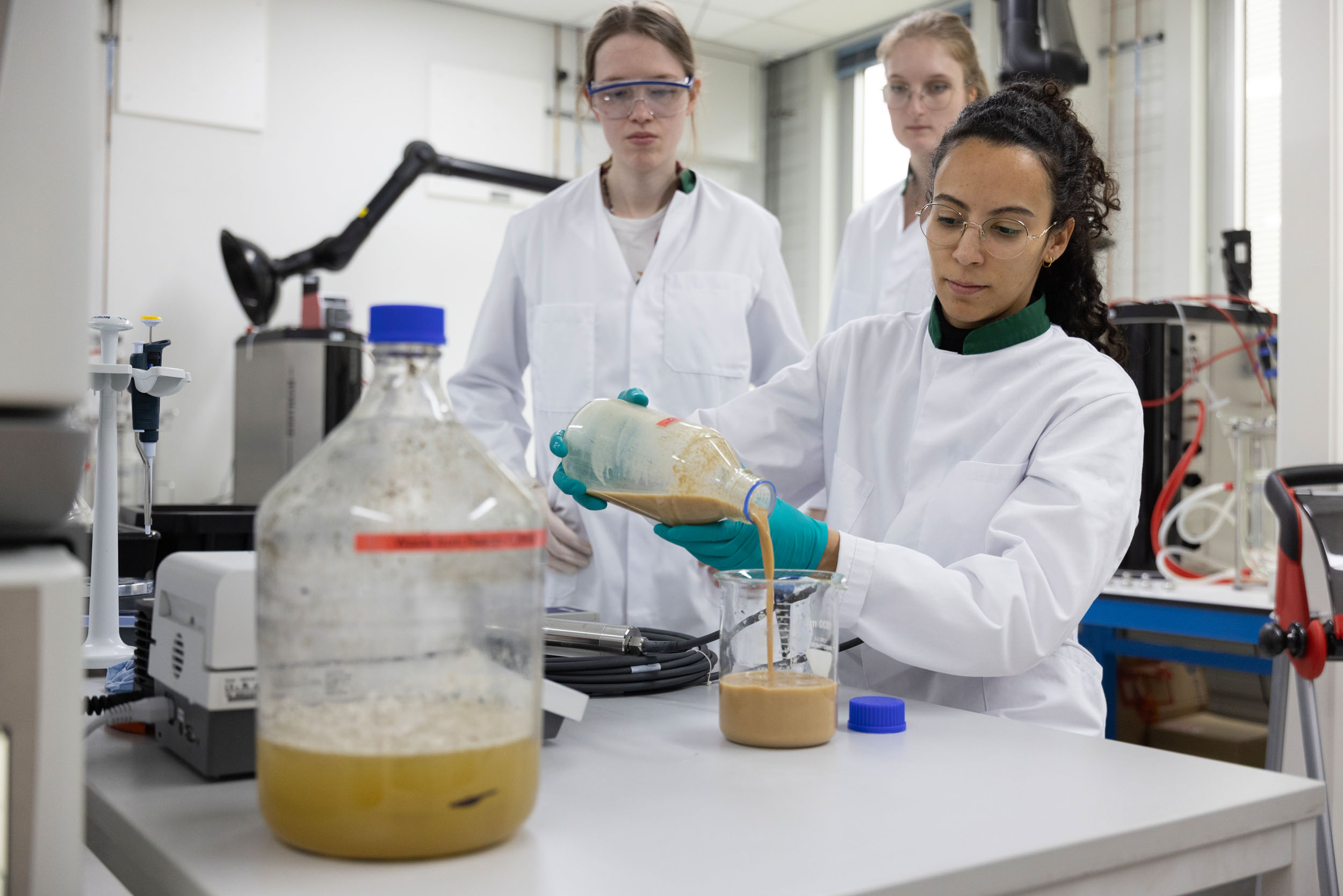
“This first step is crucial,” explains Andrade Leal. “Waste streams are first converted into fatty acids. Only then can bacteria produce PHA. If we can better control the fatty acid production, the entire chain becomes more predictable.”
The challenge: variable waste streams
Industrial waste streams are not a homogeneous constant raw material. Wastewater from potato processing, agriculture, or the dairy industry varies day by day, season by season, and process by process. This variation determines which fatty acids the bacteria produce.
“If you want to scale up the technology, you need to know exactly which fatty acids you are producing and in what quantities,” says Andrade Leal. “Stability is essential; otherwise, it will never be a reliable industrial process.”
Therefore, the research examined how parameters such as pH, temperature, time, and natural differences in the composition of the waste streams influence fatty acid production. By carefully controlling these factors, it is possible to determine whether mainly acetic acid, propionic acid, lactic acid, or butyric acid is produced.
Innovative predictive model
The project resulted in a first step towards an innovative model that integrates biological and chemical data. With this model, researchers can accurately predict which fatty acids are produced from which waste streams, making the first, often unpredictable, step of the PHA chain more reliable. An essential factor for industrial-scale production.
The development of the model is based on new experiments as well as data from previous MNEXT projects. This approach not only provides perspective for PHA production but also for other biobased markets. Fatty acids can be used as building blocks for a variety of products. These products are still produced from fossil resources, but the market for biobased alternatives is rapidly growing.
Collaboration across the chain
Each partner in the project played a key role. Cargill provided starch-rich wastewater, Looop contributed waste streams from the dairy and agricultural sectors and explored new business cases, and Paques Biomaterials brought expertise on the conversion of volatile fatty acids to PHA and gained new insights into which mixtures of fatty acids are suitable for stable production.
Internal collaboration at MNEXT was also crucial. The Smart Fermentation research group worked closely with Andrade Leal on experiments and data analysis for the model.
Second-generation feedstocks
The project worked exclusively with second-generation biomass: organic residues that do not compete with food production. This is a key pillar for sustainable growth in biobased materials.
“Industries need to treat these waste streams anyway before discharging them,” explains Andrade Leal. “Currently, they are often converted into biogas. That is already good, but perhaps we can turn them into something even more valuable. That’s exactly what we are exploring here.”
Looking ahead: scaling up and public acceptance
Although the project has concluded, research on PHA production is far from over. The results provide a foundation for follow-up projects in which:
- the model is further developed into a predictive and controllable fatty acid production tool,
- the entire value chain, from lab to market, is addressed,
- the technology is further scaled,
- and companies are assisted in effectively using waste streams as raw materials.
Public acceptance is also important: consumers and companies need to understand that products made from waste streams are valuable, safe, and sustainable.
“It’s not just about the technology,” says Andrade Leal. “We also need to tell the story behind that technology. Only then can biobased materials truly take off.”
Want to collaborate with us on this topic? Please contact Mithyzi Andrade Leal.
The ImPHAct project was funded by TKI BBE.