



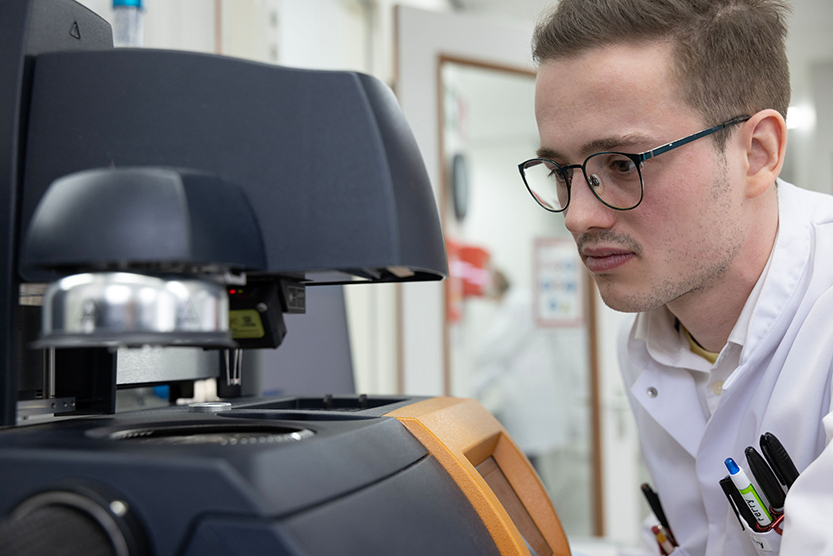
Plasticizers are substances that make plastics soft and flexible. In many applications, these are still based on fossil raw materials. Within the BIO-CAPPP project, MNEXT and TNO therefore investigated more sustainable alternatives to traditional plasticizers.
“Within this project, TNO developed several renewable plasticizers, and we evaluated them in PLA to assess the effectiveness of these new plasticizers,” says Ferry Oomen, lead author of the publication and researcher at MNEXT.
Practical relevance
In the study, new plasticizers were tested in PLA, a biobased plastic, to assess whether they could form a sustainable alternative to traditional plasticizers. The results were promising enough to be developed into a scientific publication, which has now been published.
The practical relevance is significant. If these kinds of alternatives continue to perform well, they could help make plastics more sustainable without compromising flexibility and processability. In this way, the research represents another step toward more sustainable raw materials for everyday applications.
According to Ferry, follow-up research remains important. “Naturally, you also want to ensure that plasticizers do not migrate over time — in other words, that they do not leak out or become less effective.” Follow-up research will therefore focus, among other things, on long-term performance and practical applicability.
Interreg Flanders-Netherlands
The BIO-CAPPP project has a total budget of €4.3 million and is co-funded by Interreg Flanders–Netherlands, the cross-border cooperation programme supported financially by the European Regional Development Fund, VLAIO, the provinces of Antwerp, East Flanders and North Brabant, and the Dutch Ministry of Economic Affairs and Climate Policy.
Het laatste nieuws
09-07-2026
White paper: Feeding Refineries
29-05-2026