


Two students from different educational backgrounds investigated the same research question for this material development with their own approach. The research question was: What is the feasibility of fabricating a mycelium-clay composite in a scalable manner? Students were provided with a list of possible species and substrates/nutrients, as well as the protocol for using mycelium to create composites – the rest was up to the students, the knowledge they’ve been developing during their academic career, and their creativity.
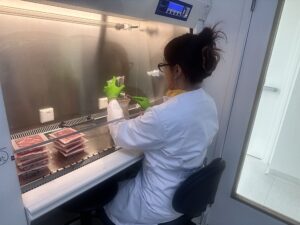
Winnie Yang, a Biomedical Laboratory Research (BML) student at Avans, focused during her internship on the biological side of the material research: how does mycelium grow in combination with clay and which conditions influence this growth? Among other things, she investigated the influence of nutrients, clay conditions, and inoculation methods on the development of mycelium.
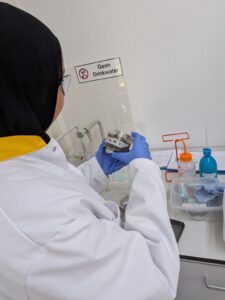
Hawa Ahmed, an Environmental Science for Sustainability, Ecosystems and Technology (ESSET) student at Avans, investigated during her graduation project how different combinations of mycelium, clay and fibre materials can lead to a strong and usable composite material. Her research focused on the development of the material structure: which compositions provide sufficient mycelium growth, a good internal structure and enough strength for further investigation.
Both studies took place within a field of material development where many aspects are still unknown, and in a multidisciplinary way combining biology, materials science, clay mineralogy, and civil engineering. This was precisely what made it interesting: by carrying out experiments, analysing results and making choices based on what became visible in the lab.
Winnie: research into the biological side of mycelium growth
Winnie entered a new context from the Biomedical Laboratory Research programme. She already had experience with mycelium from previous projects, but not within biobased building materials. “During my previous projects I had already worked with mycelium, but not in this direction. I wanted to see what it would be like in another field.”
Within MycoClay, Winnie investigated the biological side of the material research: how does mycelium grow in combination with clay and which conditions influence this growth? An important part of this was investigating which nutrients mycelium needs to grow well.
In her research, Winnie looked at the influence of nutrients such as glucose and yeast extract. Her observations showed that adding these nutrients could support growth and that differences were visible in the speed of growth. Winnie emphasises that she was not able to fully test this and therefore does not draw firm conclusions.
“With nutrients you can really see a difference in speed of growth. But it also immediately brings other problems.”
One of these problems was contamination. Especially with glucose, there was a risk because other microorganisms can also use it as a nutrient source. Therefore, Winnie sees possibilities for follow-up research, such as testing other carbon sources, further investigating the glucose concentration, or looking at which nutrients are best suited for the material.
She also investigated the influence of the clay and the way in which the mycelium was introduced. Hydrated clay provided better conditions for growth than dry clay. A solid inoculum also performed better, because the mycelium had already grown on a substrate before it was added to the material.
Hawa: development of mycelium-clay composites
During her graduation research, Hawa investigated which combinations of mycelium, clay and fibre materials can lead to a strong and usable composite material.
Hawa studies Environmental Science, a broad programme in which subjects such as sustainability, technology, ecology and laboratory research come together. Her choice for MycoClay came from the desire to explore a new field during her graduation research.
“It is a composite material that is not yet well known. That makes it interesting, because you can investigate what information you can get from it and how you can continue with it.”
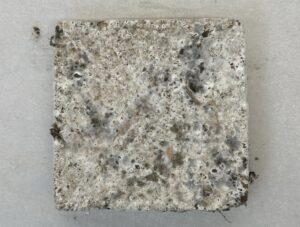
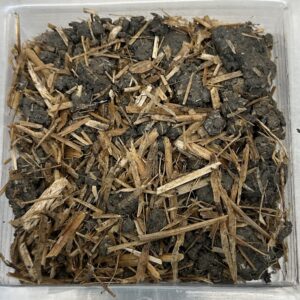
Within the project, Hawa worked with different combinations of mycelium, clay and fibre materials such as hemp shives, miscanthus and rapeseed straw. The aim was to investigate which compositions could lead to sufficient growth, internal structure and stability of the material.
An important part of her research was the systematic testing of different formulations. She looked at visible external mycelial growth, as well as internal development by cutting samples open. Based on these observations, formulations were selected or excluded.
She also investigated different ways in which the mycelium was introduced into the clay. The solid inoculation method provided an advantage according to her, because the mycelium had already gone through a growth phase before it was applied to the composite. In addition, she looked at the influence of environmental conditions, such as humidity, and investigated whether mycelium could also show growth under lower humidity conditions.
Research means continuously adjusting
Both Winnie and Hawa noticed during their research that experiments do not always proceed according to a fixed plan.
For Winnie, this meant that the research direction changed relatively early during her internship. After feedback from a Mycelium Group meeting, the approach was adjusted, which placed more emphasis on the biological properties of mycelium growth. As a result, her previous plans had to be rebuilt.
“Within one week I had to completely adjust my approach. That was a challenge, but it is also part of research.”
Hawa also noticed that research does not always follow a fixed plan. While previous projects during her studies were often carried out in groups, it was an important step for her to now shape her own research project and make choices about the next steps.
An important learning point for her was to spend less time planning far ahead and to start sooner.
“You can always plan, but it never goes exactly the way you think. The most important thing I learned is not to spend too much time planning, but to start earlier.”
By using results as a starting point, she learned to adjust her research step by step and to look critically at the outcomes.
Collaboration within MycoClay
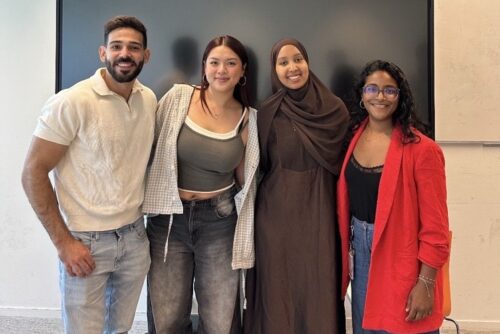
Although Winnie and Hawa investigated different parts of MycoClay, they were able to support each other from their own backgrounds and expertise.
Within the project, regular meetings were important to discuss results, ask questions and discuss choices within the research.
For Hawa, guidance played an important role during her graduation research. By receiving questions in return and being encouraged to think about possible next steps herself, she learned to make more independent choices within her research.
In addition, Hawa valued working with people from different backgrounds. Although her research focused on the development of the composite material and other team members looked at the process from a more biological perspective, they were able to complement each other by looking at the research from different perspectives.
“It was nice that we could help each other in that way. Even though we had completely different backgrounds and our research eventually became very different, we were still able to support each other.”
For Winnie, collaboration within the team was also important. During her internship, she first tried to solve problems herself by looking at literature or carrying out her own experiments. When she could not solve an issue, she could rely on the guidance and the meetings within the team to discuss results and further determine the direction of the research.
Winnie especially valued that she was increasingly seen as a colleague within the project and not only as an intern.
“I was also told that I was not working with an intern mindset, but more like a colleague.”
Winnie and Hawa also valued their collaboration with each other. Although their research directions were different, they were able to support and complement each other from their own expertise.
MycoClay as a future material
Both Winnie and Hawa see potential in MycoClay but emphasise that further development is still needed before the material can actually be applied.
Hawa indicates that the results are still in an exploratory phase. Repeating tests and further optimisation are needed to confirm results and to further develop the material towards possible applications. She therefore wants to continue following how the project develops and which steps are taken in future research.
Winnie is also interested in the future of MycoClay. She sees many open questions regarding moisture balance, scalability and the behaviour of the material over a longer period of time. For her, the research mainly shows how much there is still to discover within the development of this new material.
For both students, the value of the research lies not only in the results, but also in the process: experimenting, making choices, adjusting and continuing to investigate what works.
Het laatste nieuws
25-09-2026